
While the majority of travelers to Antarctica chose a cruise departing from South America, there truly are a multitude of ways to visit. These include:
- Cruises from Chile or Argentina to the Antarctic Peninsula. The Antarctic Peninsula projects from West Antarctica towards Tierra del Fuego at the southern tip of Chile and Argentina. This trip requires sailing the Drake Passage, a 1 and a half or 2 day crossing where seas can be quite intense. The shorter crossing distance, the striking mountainous background of the peninsula, and the number and variety of fauna to be seen makes it the favored route for most travelers. Multiple companies offer these trips during the Austral Summer Months (late October, November, December, January, February, early March). Many offer stops at additional subarctic islands such as the Falklands, South Georgia, South Orkneys, and South Shetlands.
- Cruises from Hobart Tasmania (Australia) or the South Island of New Zealand to Western Antarctica, typically to the Ross Sea or Commonwealth Bay areas of Western Antarctica. This crossing takes anywhere from 5 to 7 days each way, sometimes broken up with visits to subarctic islands.
- Flights to Antarctica, while encompassing a very small percentage of overall visits, are a growing trend.
- Quantas, the Australian airline offers 1 day sightseeing flights (typically 12-15 hours duration depending on departure city – Perth, Sydney, Melbourne, Brisbane), with 4 hours spent overflying the Antarctic continent.
- Swoop, a travel company, offers charter flight packages that typically fly from Punta Arenas or Puerto Natales (Chile) to King George Island in the South Shetland Islands (southernmost airport in the world, 120 km/75 miles from Antarctica), avoiding the 2 day Drake passage crossing on a ship. From the KGI airport they even offer 10 hour charter sightseeing flights overflying the South Pole.
- Finally, 2 travel companies in South Africa offer a 1 day charter jet trip from Capetown, with a 5 hour flight to an ice runway in the Wolf’s Fang Mountains of East Antarctica, including a hike to the summit of Nunatak Mountain, followed by a return flight to Capetown. For those to whom money is no object, White Desert travel company extends it to a 6 day stay with further mountain ascents.
Antarctic Cruising Facts and Tips: Antarctic Cruise Ships that provide landings tend to be much smaller expedition style ships, often with reinforced hulls and specialized entry/exit ports for launching zodiacs, kayaks, larger sightseeing craft, and even submarines. The vast majority of cruise companies offering antarctic landings abide by International Association of Antarctic Tour Operators (IAATO) rules limiting the number of passengers making landings each day and providing strict guidelines for landings. Consequently expedition ships tend to be small, carrying less than 200 passengers. The larger ships (200-499 passengers) try to offer multiple opportunities for landings with other exploration offers for those not landing on a particular day or time (the smaller ships that do provide landings under IAATO rules are limited to no more than 100 people ashore at any 1 time, and are required to maintain a ratio of 1 crew member ashore for each 20 passengers to ensure guidelines on not disturbing native animals, vegetation, and the landing sites are strictly followed). Large cruise ships with 500 or more passengers, such as Princess, Norwegian Cruise Lines, MCS, Celebrity, etc. may sail to Antarctica, however, they are not allowed to provide landings on any antarctic islands or the continent.
Our own trip to Antarctica provides a wonderful example. We were on the Viking Cruise Lines Expedition Ship Octantis (they also have a sister expedition ship, Polaris), which carries a maximum of 390 passengers. Multiple landings ashore were provided with only 100 ashore at a time, and those not landing had opportunities for kayaking, sightseeing on zodiacs, sightseeing on the larger and faster Special Operations Boats, and trips on the 2 submarines carried aboard the Octantis at the same time the landings were being conducted. Many shipboard exploration opportunities were also offered at the same time, including working with the scientific research teams traveling onboard or lectures by naturalists, scientists, or crew. Or one could simply enjoy being on a luxury ship in the heart of the Antarctic and the opportunities that implies.
Our Trip to Antarctica: Viking Cruise Line Expeditions “Antarctica Explorer”
ANTARCTIC EXPLORER
Wednesday February 28: Finally on our way to Antarctica! Yesterday’s booked flight was cancelled due to an airport strike in Buenos Aires, so we’re heading out today to Buenos Aires with an immediate connecting flight to Ushuaia, Argentina – southernmost city in the world, where we will board the Viking Octantis for the expedition cruise to Antarctica! We are definitely crossing one off the bucket list with this trip! If the flight on Tuesday to Buenos Aires had not been cancelled, we would have had a full day to tour Buenos Aires, spent the night at the Hilton, then flown to Ushuaia today. We will have a day to tour Buenos Aires when we return from Ushuaia following the cruise.
Wednesday February 28, Thursday, February 29 – Flights to Buenos Aires and Ushuaia, Argentina: left Atlanta on Wednesday evening, arrived in Buenos Aires early Thursday morning, then a 3.5 hour flight to Ushuaia. The central part of Argentina claims to be the bread basket of South America, with farms stretching as far as we could see from the plane. The spectacular and breathtaking Patagonian Alps, part of the Andes mountains, blanket the western side of the southern part of Argentina, along with Chile, sitting to the west. The views of the Patagonian Alps on this flight were incredible, with Massive Glaciers sitting atop the mountains. Ushuaia claims the title of the “southernmost city in the world”, perched on a harbor, with the Patagonian Alps looming directly behind the city. It is located on the bottom of the South America continent, on the Strait of Magellan, with a series of large island archipelagos known as Terra del Fuego (“Land of Smoke”), lying beneath it.
Thursday February 29, Friday March 1 – Sailing the Beagle Channel and the Drake Passage: We boarded our expedition ship, the Viking Octantis, Thursday afternoon and that evening headed out the Beagle Channel for our 2 day crossing of the Drake Passage. The Beagle Channel is a large strait extending north-south through the Tierra del Fuego archipelago (the South American lands below the Strait of Magellan). The channel separates Chilean from Argentinean portions of Tierra del Fuego and with Ushuaia at its northern tip, was named for the British Royal Navy ship (HMS Beagle) that carried Charles Darwin up the Strait and the Channel on his naturalist exploration in 1832. The Drake Passage connects the southernmost reaches of the Pacific Ocean and the Southern Ocean with the Atlantic Ocean. We have been very fortunate on our cruise, as the Drake passage so far has been very mild (waves 10-12 feet) as opposed to its famed ferocity (waves reaching 40 feet or more). Our passage is referred to as “Drake Lake” weather rather than “Drake Shake”, however, as both of us are susceptible to seasickness we had taken precautions including wearing a transdermal scopolamine patch behind the ear and anti-nausea pressure point wrist bands as we set out. Tomorrow (Saturday) we will reach the Antarctic Peninsula. Alex and I will do our first zodiac cruising in Antarctica late that afternoon, if the weather allows.
Saturday March 2 – Melchior Islands, Antarctic Peninsula: This morning we reached ANTARCTICA! The weather crossing the Drake passage was relatively calm and we were treated to blue skies and sunshine! First stop was the Melchior Islands, part of the Palmer Archipelago, a cluster of islands just off the coast of the Antarctic Peninsula. The Octantis anchored in Dallman Sound. Breathtakingly beautiful! We did our first excursion, a cruise on a RIB Zodiac (rubber inflatable boat) out to the nearby islands and icebergs. We had sightings of fur seals, Weddell seals, cormorants, petrols, and multiple sightings of humpback whales. We finished the evening with a group of humpback whales passing right by the bow of the Octantis, singing to us!
Sunday March 3 – Petermann Island, Antarctic Peninsula: we were originally scheduled to take our first hike ashore this morning to a Gentu Penguin colony on Pleneau Island. What we had heard about cruising in Antarctica is that you have to be flexible because weather or conditions may not work out. Today sea ice by the shore at Pleneau was too thick to land safely, Viking switched to Petermann Island but ice on the shore rocks there was too treacherous to unload passengers. We were instead given zodiac cruises around Petermann Island where we could observe the massive penguin colony almost as well as if we were onshore. The day finished with a spectacular passage through the narrow Lemaire Channel that separates the Antarctic Islands from the Antarctic Peninsula.
Monday March 4 – Damoy Point Weincke Island Antarctic Peninsula: our first landing in Antarctica! Another beautiful sunny day – highly unusual for this time of year as Antarctica moves from Summer into Fall. The lagoon was iced over and we heard it cracking beneath us as the zodiac headed to the shore. We landed at Damoy Point on Weincke Island, a historic British research outpost, active from the 1950’s to 1990’s. Trekked across the ice fields to view several Gentu penguin colonies. Later in the day we did a cruise to Port Lockroy Station (British Research Center manned in the summer) in a Viking Special Operations Boat, much more comfortable and much faster than the zodiacs. Saw Fin whales and a leopard seal. Back onboard the Octantis, the Viking crew held an outdoor bbq on the top deck (a Viking Expedition tradition). It was a truly wonderful and memorable experience, dining at outside tables on the top deck, surrounded by the snow covered shores and mountains of Antarctica on a sunny late afternoon and evening.
Tuesday March 5, Wednesday March 6 – Danco Island Dorian Bay, then Paradise Bay Antarctic Peninsula: After three sunny days, typical Antarctica weather set in on Monday night – rain, sleet, hail. Tuesday we arrived at Danco Island with winds of 25 to 35 knots, waves of 6-7 ft, canceling all landings and on-water activities. Slightly better weather today, Wednesday, at Paradise Bay Antarctica with low winds, rain and occasional snow, let us head back out. We did an outing on a Special Operations Speedboat in the morning on Paradise Bay and on a zodiac in the afternoon to Almirante Brown Base, an Argentine Research Center. Lots of sightings of Humpback Whales, Gentu Penguins, Antarctic Cormorants, Lesser Terns, and calving glaciers.
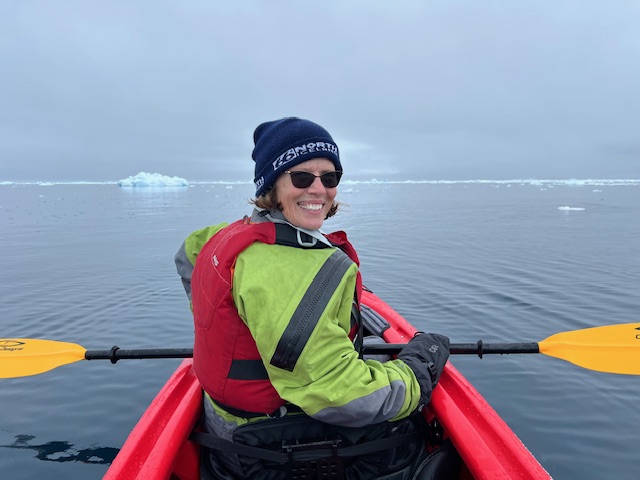
Thursday March 7- Neko Harbor, Antarctic Continent/Antarctic Peninsula: the weather improved somewhat and we had an exciting day at Neko Harbor, Antarctica. Morning: We started with a zodiac trip to land on the Antarctic Continent – surrounded by over a thousand Gentu penguins, a massive elephant seal, a fur seal, and several types of sea birds, all with a mixture of rain and snow falling on us! Afternoon: After the landing in the early morning we enjoyed a kayak trip through the ice floes in Neko harbor, wearing “Dry Suits” to keep us from freezing if a kayak capsized (they were very stable and none capsized). These were our favorite excursions, as you are sitting right on the surface of the sea, surrounded by “brushies” (ice chunks), clunking against the kayak. We finished the afternoon with a ride in one of the Special Operations Boats (steel hulled jet propelled military boats) and a wonderful encounter with a humpback whale who kept calling out/vocalizing. Quite an exciting day!
Friday March 8 – Danco Island Antarctic Peninsula: a busy but bittersweet day – our last full day in Antarctica. The day began with an 8:30 AM landing on Danco Island, followed by kayaking at 10:30, and our expedition ended with the last Special Operations Boat (SOB) cruise on this trip. We had some wonderful penguin encounters while ashore – including watching a penguin mom trying to keep her two fledglings from picking on each other. On the kayak trip it was all experienced kayakers, so our guides let us paddle almost the length of the harbor (we did 1.69 miles), leaving the ship far out of sight. On the SOB cruise we encountered 2 humpback whales traveling side by side. At 5:00 PM, the ship set sail to head back to Ushuaia, Argentina (with another 2 day passage across the Drake Strait).
Saturday and Sunday March 10 & 11 – Sailing the Drake Passage and Cruising Tierra del Fuego: finished sailing the Drake Passage and sailed around Cape Horn (the southernmost point of South America), on the Tierra del Fuego archipelago, where the southernmost Pacific Ocean, Southern Ocean, and Atlantic Oceans join. Interestingly, this time last March we were at the Cape of Good Hope in South Africa, at the bottom of the African continent!. Our return Drake passage was a little rougher this time, with waves 12-16 feet, but still more of a “Drake Lake” than a “Drake Shake” cruise. Our final day onboard we got to tour the hanger area of the Octantis, where all the zodiacs, SO Boats, kayaks, and submarines are stowed. A final farewell dinner onboard on March 10th was held upon our arrival in Ushuaia, Patagonia Argentina, and on the 11th we disembarked the Octantis and flew to Buenos Aires, arriving in the late afternoon at the Hilton Hotel, located in the Puerto Madero District of Buenos Aires. It was raining off and on, we tried to venture out for dinner, but I had picked up a cold/rhinovirus on the trip and was quite miserable (I did a COVID self-test and luckily it came back negative!), and we decided to just get food at the hotel.
Monday and Tuesday March 12 & 13 – Buenos Aires and Homeward Bound: our flight leaves tonight at 8:55 PM, arriving in Atlanta at 6:20 AM on March 13. The intermittent rains finally broke in late morning and I was feeling better, so we ventured out to stroll the Puerto Madero dockyards area of Buenos Aires with its very futuristic modern architecture, beautiful bridges and harbor areas, and had a wonderful lunch on a docked sailing ship/restaurant before the rains hit once again. The lack of opportunity to explore Buenos Aires was the only disappointment of the trip.
 meanderingmolts.blog
Leave a comment