
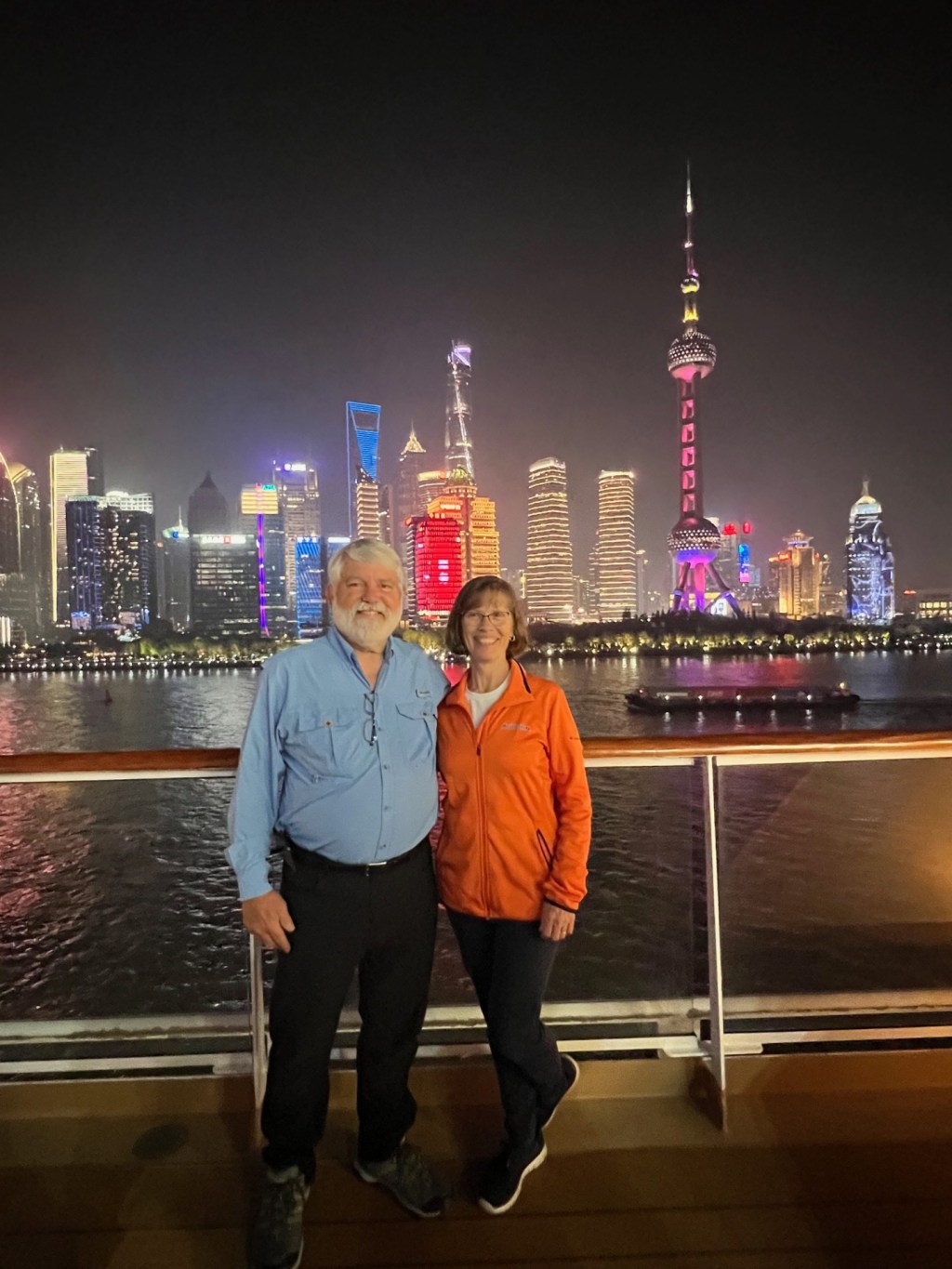
Viking is one our favorite Cruise Lines, and in 2024 they announced a return to China, at least on an experimental basis, for the Fall of 2024. We did “Classic China and the Coast” with Land excursions in Beijing and Xian, a cruise down the South China Sea coast on the Viking ship Yi Dun from Shanghai to Shenzhen, and then a land extension in Hong Kong and Macau. What follows is a brief summary of our adventures.
Day 1 in China: Tiananmen Square and the Imperial and Forbidden City.
Beijing is enormous, with a population of 23 million!
Today we toured through Tiananmen Square, largest city square in the world, and then on through the former palace complex of the Emperors of the Ming and Qing dynasties from 1420 – 1920, known as the Forbidden City. Both the Square and the Forbidden City lay within the city walls of the ancient Imperial City, although most of the city walls have been removed. Tiananmen Square is surrounded by monuments and buildings bearing on the history of China and the Chinese Communist Party, including the Great Hall of the People (the house of the Chinese legislature), Monument to the People’s Heroes, the National Museum of China, the Mausoleum of Mao Zedong, and the Tiananmen Gate (“Gate of Heavenly Peace”) located to its north, which separates it from the Forbidden City and from where Mao declared the founding of the People’s Republic of China in the square on October 1st 1949. The Forbidden City is a massive walled complex surrounded by a moat, the center of ancient Beijing and is the largest palace complex remaining in the world. The number of buildings and vast number of rooms (supposedly 9,999 rooms) where the emperor and empress and the emperor’s concubines, eunuchs, servants, and soldiers lived is massive and opulent and covers over 2 miles.
Day 2: Great Wall of China and the Sacred Way of the Ming Emperors.
With a very early start to the day we headed to the Badaling section of the Great Wall of China, about 60 miles NW of Beijing. This section was built by the Ming Dynasty in 1504, to protect a key pass in the mountains that would have made Beijing vulnerable to attack from the Mongols. This section is the most visited portion of the Great Wall, which stretches irregularly over 13,000 miles across China, with the Ming section about 5,500 miles. It was incredible to stand atop the wall and see the wall stretching across the mountains, heading in multiple directions. This section had been restored but it was challenging walking – with uneven surfaces, some sections steeply sloping, and no real pattern to the height of each step when stairs were involved. It was a true bucket list moment for both of us and I kept saying “can you believe we’re standing atop the Great Wall?!!”
After lunch our tour headed to the “Sacred Way”, a walking path leading through the forest to the underground tomb complexes of 13 of the Ming Emperors on the southern slope of Huangtu Mountain (now Tianshou Mountain). The site was chosen based on the principles of “feng shui” by the third Ming emperor, and subsequent emperors followed his lead. The path is lined by columns and statues of both fictitious mythical animals, common animals, and humans. Only one of the tombs has been opened and explored in modern times, and is not available to the public.
Day 3: Temple of Heaven, Beijing and flight to Xi an.
This morning we headed to the massive grounds of the Temple of Heaven, a complex of religious buildings built during the early Ming Dynasty in 1420. Originally the Temple of Heaven and Earth, a second temple celebrating the Earth was built by a later Emperor in 1534. The grounds are beautifully wooded with pine, cedar and cypress trees, some more than 400 years old. In the center is the beautiful circular Hall of Prayer for Good Harvests, where the emperors of both the Ming and Qing dynasties made animal sacrifices and gave prayers to Heaven to ensure bountiful harvests. There were 3 sacrificial sites on the temple grounds, all circular to represent Heaven, one was outdoor, two were indoor.
After the tour we headed to Beijing’s new Daxing International Airport, even larger than Beijing International Airport, for our flight to the ancient Chinese capital city of Xi an.
Day 4: Xi’an, Terra Cotta Army, and Cultural Dance Performance
Xi’an is laughingly considered a “small city” in China, only 13 million residents! An ancient capital of China for 1,500 years, it was home to the Zhou, Qin, Han, Tang, and 9 other dynasties. It marked the eastern end of the fabled “Silk Road”. It was the home to China’s first emperor, Qin Shi Huang, and it is where the Bingmayong (Terra Cotta Army) was buried as part of his underground tomb in 210-209 BCE, to protect him in the afterlife. There were no historical records of the army, so it laid undiscovered for 2200 years until farmers digging a well on a field found fragments of terra cotta figures. So far 2000 have been disinterred, it is estimated there are 8000 life-sized figures overall, including horses, chariots, archers, foot soldiers, and the face of each is unique. It is believed they were originally stationed in deep pits in long formations under wooden roofs covered with earth forming a subterranean structure. The roofs eventually collapsed, breaking the army underneath, and floods buried them under several meters of earth. Archaeologists have to rebuild each one from the broken fragments.
That evening we attended a performance of Tang Dynasty era dancing and musical pieces using ancient style instruments at the Shaanxi Grand Opera House.
Day 5: Final day in Xi’an, flight to Shanghai, board the Viking Cruise Ship Yi Dun.
This morning we toured the city walls of Xi’an. The walls surrounded the Imperial City in Xi’an, the home of the emperor. The original walls were built in 618 under a Tang Dynasty emperor, and made more massive by the first Ming Dynasty emperor in 1370, and enlarged even more in succeeding centuries. The walls stretch 8 miles in a rectangle around the old Imperial City with an impressive width and a great view from 3 stories up of the city center. A massive Saturday street market was operating next to the city walls.
Flight to Shanghai was on a brand new China Eastern Cormac C919, the new state-sponsored aircraft manufacturer from China. Finally made it to the ship about 5:00 PM. The ship’s mooring is on the Huang Pu River, in the Bund area, a neoclassical former colonial area, but in close proximity to the CBD. China is still celebrating October 1 on the Chinese calendar (November 1 on ours) a very auspicious day. The skyscrapers along the river were all putting on fabulous light shows in celebration of the date.
Day 6 & 7: Shanghai city Day 6 and sailing on the South China Sea Day 7.
Shanghai began as a small fishing village on the northern side of the Yangtze River Delta about 5,000 years ago. It was one of five port cities forced open by western powers after the first Opium War in 1839-1842. That opening to world access is what made Shanghai the economic powerhouse that it is today, and the 3rd largest city in China with 24.6 million residents. Shanghai welcomes trade and tourism, and the number of massive skyscrapers, including Shanghai Tower (3rd tallest in the world) speaks to its economic prominence. We visited the Yu Gardens, established during the Ming Dynasty, and a trip to Najing (Nanking) Road shopping area (all very high end luxury shops), did a 5 mile walk down the Huangpu riverfront promenade along the Bund (former British and French colonial area in Shanghai), and capped it off with a fabulous Chinese Acrobatic performance in the ERA stadium. November 4th was spent cruising south on the South China Sea to the opposite side of the Yangtze River Delta to Zhoushan archipelago, with over 1400 islands.
Day 8: Zhoushan Archipelago.
This is the most famous fishing area in China, with the nutrient rich waters of the Yangtze River mingling with the South China Sea. It is said this region feeds all of China with fish. We did a tour of the ancient fishing village of Dong Sha, on one of the islands. Modern fishing methods have left the town without the industry, and it has been restored as an example of ancient traditions and crafts. We enjoyed opportunities to try dragon dancing, silk finger puppets, and telling of ancient fables to traditional music. The tour continued to the modern city of Daishan, then back to the ship. While the main religion of China was Taoism, Zhoushan (older name: Chusan) is the site of one of the world’s four sacred Buddhist shrines, this one to Bodhisattva Guanyin, goddess of mercy and the physical embodiment of compassion. Our day ended with a spectacular 360° nighttime outdoor performance celebrating the Bodhisattva by the director of the Beijing 2008 and 2022 Olympic opening ceremonies.
Day 9: the port city of Dongtou, China.
We continue cruising south along the coast of southern China, arriving today at Dongtou. Like Zhoushan yesterday and its 1400 islands, Dongtou is the largest island in a 168 island archipelago. It has a strong fishing tradition, but its cities are the northernmost where private manufacturing companies are allowed to produce and export goods, so it’s a thriving port and manufacturing center. Our trip today was a hike along the towering rock cliffs of the Xiandie Rocks Scenic Area. After descending about 1/2 way down the cliffs, the scenic trail is suspended from the cliff face allowing views of the cliffs above, the rocks and crashing waves below, and incredible views out of the other islands in the South China Sea.
Day 10: Pintang China.
In an effort to create tourism along the coast from Shanghai to Hong Kong, Viking visits what it euphemistically calls “less discovered ports”. Our stop today, Pintang Island in Fujian Provence, is a classic example. Fujian has always been a center for the fishing industry but now its attempting to capture Tourism too, billing itself as the “Maldives of China” because of the hundreds of small islands. Our tour today took us further down the island of Pintang, to an attempt by the government to create a replica of an ancient Chinese fishing village, called Haitan Ancient Village as a tourist attraction. Built in 2017 at a cost of 2 billion USD, the attraction failed to attract Chinese visitors and the majority of shops and restaurants in the replica buildings have closed, but there was a fascinating Maritime Museum there with a full sized replica of a Chinese warship used in coastal defense from smugglers and from foreign invaders. A formidable naval base was developed on Haitan/Pintang Island during the Qing dynasty to protect its southern coast and the island of Taiwan.
Day 11: Xiamen Island, Xiamen, Quanzhou
Unlike our last 2 ports, Xiamen is a major city of over 5 million encompassing 2 islands and combined with neighboring Quanzhou, over 10 million. During British colonial times it was known as Amoy. It is a charming city celebrating its early dynastic founding, colonial times, and now serving as one of the 4 special economic zones of China, a modern financial and manufacturing center, as well as the largest port in South China. We toured neighboring Quanzhou, visiting one of the oldest and largest Buddhist Temples in China, a Muslim Mosque dating back to 1049, and Taoist Temple. While religion was discouraged in the early years of the PRC, the government now has a much more tolerant acceptance. We finished with a walk across an over 1000 year old stone bridge connecting Quanzhou Island to Xiamen Island, and a fabulous light show on the sides of the business towers surrounding the harbor, similar to Shanghai.
Day 12 Shenzhen, Guangdong.
Shenzhen sits near the top of a large bay formed by the Pearl River Estuary with the Special Administrative Regions (SAR) of Hong Kong Island and Macau Island below. All are at the very southeastern corner of China. Shenzhen has a very unique story – it had always been a small fishing village, however, in 1979 PRC Premier Deng Xiaoping designated it as one of the 4 original special economic and free trade zones to encourage opening China to the West. 45 years later it now has a population of 18 million, and is the Silicon Valley as well as an important financial center of China. Our tours included a cruise around the harbor and a trip to the Shenzhen Cultural Museum and a hike up Lianhuashan Park for a magnificent view of Shenzhen and the islands of Hong Kong and Macau in the distance.
Day 13: Hong Kong SAR
When the British handed over Hong Kong in 1997, and the Portuguese handed over Macau in 1999 to the PRC, both were designated Special Administrative Regions (SAR), the only 2 regions in China where capitalism would be allowed to continue for 50 more years, known as China’s One Country, Two Systems policy. The British had ruled Hong Kong for 157 years, after it was ceded by the Qing dynasty after the first opium war. It consists of Hong Kong island, the Kowloon Peninsula, Lantau island, the New Territories, and 200 other small islands. The population is 7.4 million. After traveling from Shenzhen, we stopped to visit the beautiful Nan Lian gardens and its Buddhist Nunnery. We checked into the Regent Hotel on the Kowloon waterfront with a view of Hong Kong Island. A walking tour of the Tsim Sha Tsi area gave time to explore, have an adventurous Hot Pot dinner at CaoCao with Dave and Melissa Marteney and ended the night with a stroll along the Kowloon waterfront, a photo with the Bruce Lee statue, and laser light show with accompanying music between the skyscrapers on both sides of the waterfront.
Day 14: Macau SAR.
We took a jet boat from Hong Kong to Macau, an island in the Pearl River Estuary just like Hong Kong. It was leased to Portugal by the Ming Dynasty in 1557. In 1887 it was ceded to Portugal and remained in their control until it was returned to the PRC in 1999. In 1999 there was a single casino; under PRC rule there are now 32, most of them mega casinos, many with American names such as MGM, Venetian, Sands, etc., although most have majority ownership by Chinese billionaires. It is the only place in China where gambling is allowed. It still has many of the colonial buildings, now dwarfed by the mega casinos. A city of 710,000 on 3 islands, there are more millionaires per capita than any other city and the streets are lined with high end stores.
Day 15: last full day in Hong Kong, a wet one with Typhoon Toraji rapidly approaching us.
The day started with a visit to the Wong Tai Sin Taoist temple on Hong Kong Island. We next had a wonderful ride on a Sampan (“Chinese Junk”) through the “typhoon shelter” harbor area with over a thousand boats, large and small, tied together in tight rows. This was followed by a wonderful lunch at a Dim-sum restaurant. We headed with our new friends Dave and Melissa Marteney on a trek to the tram station for an exciting ride to the top of Victoria Peak, for a spectacular view of Hong Kong. We finished the night with a dinner at Jimmy’s Kitchen, a Hong Kong landmark.
30 hours of travel time await us the next day. It’s been a great trip to a fascinating country with a culture and history very different from ours. A final thank you to Viking Ocean Cruises and Andrew Burkhalter at Premier Services Travel.
 Savy Senior Travelers
Leave a comment